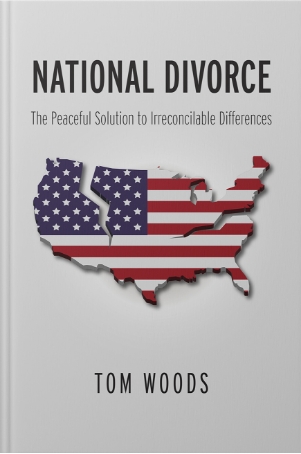
• "Well written, well researched, and the thesis put forth is well argued.... Woods has opened up an area of historical analysis that should invite further study."
    -Journal of American History

  • "During these times that challenge our freedoms there is no one more qualified to make U.S. history relevant to the fight against big government than Thomas Woods."
    -Barry Goldwater Jr.
    Former Member of Congress

  • "I strongly recommend Woods's work."
    -The Honorable Ron Paul,
    U.S. House of Representatives

  • "Written with great clarity and fluency, making the complex philosophical and theological concepts approachable."
    -Journal of American Studies

  • "A must-read."
    -Barron's

  • "An excellent reading source for anyone interested in financial markets, and much more so for anyone interested in learning about capitalism without all the misinterpretations being thrown about in the financial media."
    -Asia Times

  • "Provocative, well-written, and deserves to be read."
    -Catholic Historical Review

  • "An engaging and important contribution to scholarship on the history of American Catholicism."
    -Journal of the Historical Society

  • "Woods and [co-author Kevin] Gutzman appeal to both left and right in this constitutionalist jeremiad…. The authors' exegeses of the Constitution and court decisions, heavy on original intent arguments, are lucid and telling."
    -Publishers Weekly

  • "A marvelous read. Every chapter taught me something new and unexpected."
    -Tom Bethell, senior editor,
    The American Spectator

  • "The hottest book today is Meltdown, by my friend Tom Woods."
    -Judge Andrew Napolitano, senior judicial analyst,
    FOX News Channel

  • "Should be required reading."
    -Economic Affairs (London)

  • "Woods, one of the best classical liberal [libertarian] scholars of his generation, has once more placed us in his debt with this lucid and tightly argued book."
    -David Gordon, The Mises Review

  • "Tom Woods is one of my dearest allies in the struggle against wrong-headed and dangerous economic policy."
    -Peter Schiff

Debating Max Keiser, and Giving Away Free Books

At this point I am ignoring Max Keiser, but I’ve suspended this policy for one last video, in which I sum up our dispute over Mises and lay out a fair way in which we might resolve this. It doesn’t involve having Max interrogate me. It involves both of us being able to ask questions. I have mine all ready.

Plus, I’m using my dispute with Max as the inspiration behind my Knowledge-Beats-Name-Calling Book Giveaway. Details on that, and on the back-and-forth with Max, on this special page. Now for the video:

Unlearn the Propaganda!

  • Mike

    You see a lot of this schoolyard behaviour in society imo. I think people look at the disgusting behaviour of politicians who behave worse than schoolyard children and think that kind of behaviour is OK. That it is the way to win arguments. There is a lot of work to do before we can say that most adults behave like adults instead of being children pretending to be adults. No wonder we need a nanny govt…

  • Isaac Izzy Marmolejo

    A couple of points:

    1) Keiser is wrong in saying that since Mengerian political economics is different of Mises or Mises-like (Rothbardian) political economics that they aren’t ‘true’ Austrians

    2) There is evidence showing that Menger did think differently on these issues. You imply that Menger would have agreed with your statement, “Private individuals do better at handling property better than government”, which I admit i think he would have thought this as generally true, but there was some huge exceptions to this, according to Menger. in 1909 “Geld” he supported a government to be the sole supplier of coinage. In “Transcript of Finanz-Wissenschaft von Prof. Carl Menger”, he supported progressive taxation on income. In “Carl Menger’s Lectures to Crown Prince Rudolf of Austria”, he supported multiple regulations, including regulation to prevent deforestation, regulations to improve workers’ conditions, etc. Look here for more: https://radicalsubjectivist.wordpress.com/2012/09/12/848/

  • Mr. M.

    Good to see James Corbett get mentioned. Corbett Report is a treasure trove of great information.

  • http://www.TomWoods.com Tom Woods

    This is a real stretch. For one thing, Menger’s actual argument for progressive taxation violates his own principle of subjective value. So in that case it is Menger himself who is at war with the Austrian School. Secondly, if his argument for government money is simply that private mints aren’t reliable enough, that is very, very far from modern arguments for why governments have to monopolize money. If I could show him that private mints are more reliable than the government, he’d be an instant Hayekian. Again, I don’t see any fundamental difference here. He is not saying government has to monopolize money in order to stabilize prices, etc. THAT is where the fundamental difference between the Austrians and everyone else comes in.

    His ad hoc support for this or that program is, again, not based on Austrian principles and not advanced as if they were integral to the Austrian paradigm. They are ad hoc.

    His presentation of Austrian economics, as opposed to his obscure, ad hoc series of recommendations, appears in his Principles of Economics, which in turn strongly militates against ad hockery.

  • http://twitter.com/shanedk Shane Killian

    So Max Keiser says Mises deviated from Menger?

    Did Newton deviate from Kelper and Galileo? Did Laplace deviate from Fermat and Pascal? Scientific theories get modified, expanded, and refined over time. That’s a feature, not a bug.

  • Mr. M.

    ‘ad hockery’ – someone’s been listening to Gary North…..

  • Isaac Izzy Marmolejo

    “If I could show him that private mints are more reliable than the government, he’d be an instant Hayekian.”

    This is just an assertion. In that same paper where Menger calls for monopoly over coinage, he has a footnote which points to California and their little history of having people privately provide coinage, in which he stated he was successful … This did not change his mind on his overall view, so I do not think Menger would have became instantly a Hayekian once you showed him evidence of successful private coinage suppliers.

    But you said that you wanted Mengerian sources of him disproving the point that ‘private individuals take care of property better than government’ like you do, I think I provided it, I am not talking about the debate as a whole, I am just answering your request for Mengerian sources that

  • http://www.TomWoods.com Tom Woods

    These lectures were unknown until the 1980s, and thus did not form any part of the Austrian corpus from which anyone could have deviated. In these exceptional cases in which Menger, like Adam Smith before him, allowed for state activity, the rationales offered are ad hoc, and not integrated into the 1871 Principles text which formed the basis of the Austrian School 38 years earlier. His defense of the progressive income tax even violates his own principle of subjective value, whereas Jaitly and Keiser claim it is Mises who deviated from subjective value.

    The question of Menger and Mises as value-free scientists was the issue raised by Jaitly, who confined himself entirely to theory. On a theoretical level, Menger and Mises are borderline indistinguishable. When Menger advocates ad hoc policies 38 years later without reference to his own theoretical framework, and giving no reason to believe his theoretical views somehow demand these outcomes, he is speaking in his private capacity as private citizen and not qua economist. On deforestation, Menger is simply restating common-law principle current at the time.

  • jaffi411

    Well, Tom has been wearing snappy three-piece suits lately …

  • http://www.facebook.com/people/Paul-Sedkowski/100001467305337 Paul Sedkowski

    Hey Tom,

    You actually CAN’T have the kind of discussion you would like with Max.
    While Max knows quite a bit about quite a bit, he is primarily an entertainer who knows a thing or two about economics. Not the other way around. He’s NOT up to date on much any more, except in a few narrow fields. Economics isn’t REALLY his game. It’s TV.
    You think you’re asked to play Bridge – but he’s playing Go Fish (and like the joker he is, he never told ya).
    His public (and private) image as a know-it-ALL depends ENTIRELY on his sweeping generalizations. A dilettante viewer buys into this and laughs along with him. You’re supposed to think: “This dude is smart AND funny”. And you grow to love histrionics. Because THAT is what he is a real expert at.
    This said, it’s not infrequent that his guests disagree with him and even “set him straight”. And, to his credit, as long as they do it in a way which doesn’t undermine his Joker-in-the-pack image, Max actually tends to be quite gracious about being set straight.
    It’s about IMAGE – and entertainment – for him. So, there is no point appealing to SUBSTANCE.
    On substance – you already won, and he knows it.
    The only battle left, if you decide you want to have a laugh, is to “out-jovial” and “out-laugh” him. He’s a like capricious king of his castle who can’t stand dissent, no matter what. But he loves pranks and respects pranksters more than geniuses.
    He is INCAPABLE of winning such a specialist argument in ANY other way, except by staying in character. And by now, it’s also become a matter of face for him and it’s not about either Mises or Menger.

    You’re serious – he’s not. Bridge vs Go Fish.

  • http://twitter.com/the_chiefe71 The Chiefe

    Hi Tom,

    Pls take time to address following bogosity from pseudo-libertarian Bill Still. It even includes more bogosities from your newly found friend Max Keiser as justification for “strengthening” his argument.

    Fake Libertarian Gold Solution is a Dangerous Lie

    http://www.youtube.com/watch?v=WVlqwJ00LMU

    A red-flag lie I’ve detected in his argument is as follows:

    According to him, von Mises Austrian economists are obsessed with gold standard, but never address problem with fractional reserve banking. I feel this statement is patently false. I also feel his implicit assumption that “adopting gold standard” and “ending fractional reserve banking” are 2 totally independent mutually exclusive events is WRONG. There is nothing stopping adoption of gold standard & abolishing fractional reserve banking at the same time.

  • markram

    My advice, stay as far away from Max as possible. He seems to be clearly on a self destruct and I don’t think he cares who he takes with him. Its not worth the effort it takes to be embroiled with this.