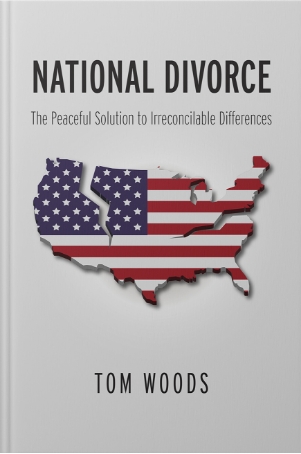
• "Well written, well researched, and the thesis put forth is well argued.... Woods has opened up an area of historical analysis that should invite further study."
    -Journal of American History

  • "During these times that challenge our freedoms there is no one more qualified to make U.S. history relevant to the fight against big government than Thomas Woods."
    -Barry Goldwater Jr.
    Former Member of Congress

  • "I strongly recommend Woods's work."
    -The Honorable Ron Paul,
    U.S. House of Representatives

  • "Written with great clarity and fluency, making the complex philosophical and theological concepts approachable."
    -Journal of American Studies

  • "A must-read."
    -Barron's

  • "An excellent reading source for anyone interested in financial markets, and much more so for anyone interested in learning about capitalism without all the misinterpretations being thrown about in the financial media."
    -Asia Times

  • "Provocative, well-written, and deserves to be read."
    -Catholic Historical Review

  • "An engaging and important contribution to scholarship on the history of American Catholicism."
    -Journal of the Historical Society

  • "Woods and [co-author Kevin] Gutzman appeal to both left and right in this constitutionalist jeremiad…. The authors' exegeses of the Constitution and court decisions, heavy on original intent arguments, are lucid and telling."
    -Publishers Weekly

  • "A marvelous read. Every chapter taught me something new and unexpected."
    -Tom Bethell, senior editor,
    The American Spectator

  • "The hottest book today is Meltdown, by my friend Tom Woods."
    -Judge Andrew Napolitano, senior judicial analyst,
    FOX News Channel

  • "Should be required reading."
    -Economic Affairs (London)

  • "Woods, one of the best classical liberal [libertarian] scholars of his generation, has once more placed us in his debt with this lucid and tightly argued book."
    -David Gordon, The Mises Review

  • "Tom Woods is one of my dearest allies in the struggle against wrong-headed and dangerous economic policy."
    -Peter Schiff

Don’t Like Joe Biden OR Mitt Romney? You’re a Crank

Here’s my latest video, and here’s the resource page I mention in it.

Unlearn the Propaganda!

  • Jim

    Hi Tom. The address you post on the screen is incorrect. It should read http://www.TomWoods.com/ronpaul. You need to use small letters. File addresses on the Internet are case sensitive, unlike the URL itself. Great resources, though. Thanks!

  • Anonymous

    Thanks. I noted this in the YouTube comments. We’re trying to install a plugin that will fix the problem, but I’m waiting on my old web guy to give the access info to my new web guy.

  • Crenshawfb

    Tom,

    You should consider doing a radio show. That would be AWESOME.

  • Anonymous

    Thanks. Maybe a podcast, but a radio show would be very demanding, and I have to be careful not to drive myself insane by taking on too much.

  • Bill

    +1 for the Podcast

  • Direhippo

    +1 indeed.

  • Anonymous

    One of my published comments on the Salon.com Pareene article…..

    Pareene explains the source of his deep wisdom:

    I’m from Minneapolis, I live in Brooklyn, and I once spent 18 drunken months covering DC. Politically, I’m basically your typical effete coastal liberal elitist.

    http://tinyurl.com/24jw4q9

    And we all thought he was just faking that he was unable to express, much less complete, a coherent thought. Mystery solved.

  • natmac

    Hey Tom, as always entertaining.

    I was wondering if you or any of your readers could point out to me why a gold standard would be more effective for preserving the wealth of individuals as opposed to full blown competition in currency. Or point me in the direction of some literature that addresses this.

    Personally I don’t have a desire for gold other than the fact that I recognize there is a demand for it. So if I owned gold I could simply trade it for that which I valued higher, but if a gold standard was implemented wouldn’t this favor those who hold gold as a resource over those whose wealth was held in other resources i.e. land, lumber, corn, oil, seeds, etc?

    How is the monopolization of the medium of exchange by government fixed by the gold standard? Also, does instituting a gold standard via government help to cement the value of gold against competing currencies/resources due to the fact that in order to buy and sell one is forced to deal in gold, as it would be the government forced medium of exchange? If you address these in your resources page please dis-regard my laziness

  • http://twitter.com/FringeEconomist Albert Cheng

    First they ignore you, then they laugh at you, then they fight you, then you win.

  • Brian

    Murray Rothbard’s “What Has Government Done To Our Money?” book/article is probably a good place to start.

    He explains the concept of money and what a genuine, free-market money system looks like. He explains why gold and silver emerges as money in a free-market. He explains fractional reserve banking and paper money, their destruction of wealth and savings, and how government shields and supports all of this. It’s a great read. You can download the article PDF here: http://mises.org/money.asp

    I found the following video with economist Joseph Salerno about the gold standard to be very informative. If you have an hour and a half, take a look: http://www.youtube.com/watch?v=2rsph5jLd_I&feature=relmfu

    As Salerno notes at the end, I think Austrian economists are a little divided on how to return to a sound money system. Or maybe I should say there are different approaches.

    Tom wrote in Rollback about abolishing legal tender laws, having competing currencies, ending taxes on gold and silver, and allowing private mints to issue coins as money.

    But I recall that Rothbard pointed to the problem of returning to private mints and “market” money after such a long time of legal tender, fiat currency—he pointed to Mises’ “regression theorem” as showing that nobody would accept, for example, “Tom Woods” gold or silver coins as money because these coins are unfamiliar and have not been exchanged earlier. Rothbard advocated for restoring the definition of “dollar” to a weight in gold, and then going from there. Here’s another good Rothbard article addressing, and critiquing, the competing currencies theories. It’s a good gold discussion. http://mises.org/rothbard/Genuine.asp

    I don’t know. I’m still a novice, but I find this topic fascinating and important. Maybe Tom can help us out.

  • Anonymous

    I would suggest for any Austrian newbie “The Essential Von Mises” by Rothbard. It was originally issued as a little pocket book that fit in your back pocket and it helped me greatly to understand basic Austrian School concepts back in 1974.

    http://mises.org/resources.aspx?Id=3081&html=1

    It has become clear that no Austrian School critic has the slightest familiarity with even basic Austrian School concepts.That never seems to stop the venom or the name-calling, however.

  • https://www.google.com/accounts/o8/id?id=AItOawnOeUylfSECWquJhzhAJ1tmXcSJoKyqXGo Contemplationist

    Tom

    I’m a huge fan of the Austrian school. However, I don’t think the ABCT explains all recessions very well. Nominal shocks have real effects. This has been understood from David Hume’s time and perhaps earlier. Why they do is a bit of a mystery. But its also very likely that sticky wages pay a big part in that. I would recommend you not to adopt a siege mentality on monetary economics even though Krugman and his army of haters despise you and all Austrian-minded intellectuals.
    Please read some Scott Sumner and Bill Woolsey. Bill Woolsey even claims that ABCT as propounded by Roger Garrison fits in well with theory of nominal shocks.
    On the Austrian side, please talk to Steve Horwitz about montary disequilibrium. I only recommend this, as I fear you may be treading into Rothbardian certainty and arrogance on monetary economics, which is unjustified

  • natmac

    thanks for the response, i’ll check those out.

  • Taviacantarini

    I would pay top dollar to see you in the republcan primary debate.