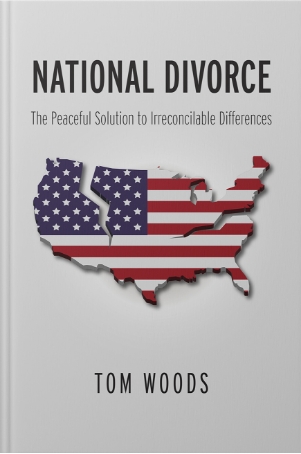
• "Well written, well researched, and the thesis put forth is well argued.... Woods has opened up an area of historical analysis that should invite further study."
    -Journal of American History

  • "During these times that challenge our freedoms there is no one more qualified to make U.S. history relevant to the fight against big government than Thomas Woods."
    -Barry Goldwater Jr.
    Former Member of Congress

  • "I strongly recommend Woods's work."
    -The Honorable Ron Paul,
    U.S. House of Representatives

  • "Written with great clarity and fluency, making the complex philosophical and theological concepts approachable."
    -Journal of American Studies

  • "A must-read."
    -Barron's

  • "An excellent reading source for anyone interested in financial markets, and much more so for anyone interested in learning about capitalism without all the misinterpretations being thrown about in the financial media."
    -Asia Times

  • "Provocative, well-written, and deserves to be read."
    -Catholic Historical Review

  • "An engaging and important contribution to scholarship on the history of American Catholicism."
    -Journal of the Historical Society

  • "Woods and [co-author Kevin] Gutzman appeal to both left and right in this constitutionalist jeremiad…. The authors' exegeses of the Constitution and court decisions, heavy on original intent arguments, are lucid and telling."
    -Publishers Weekly

  • "A marvelous read. Every chapter taught me something new and unexpected."
    -Tom Bethell, senior editor,
    The American Spectator

  • "The hottest book today is Meltdown, by my friend Tom Woods."
    -Judge Andrew Napolitano, senior judicial analyst,
    FOX News Channel

  • "Should be required reading."
    -Economic Affairs (London)

  • "Woods, one of the best classical liberal [libertarian] scholars of his generation, has once more placed us in his debt with this lucid and tightly argued book."
    -David Gordon, The Mises Review

  • "Tom Woods is one of my dearest allies in the struggle against wrong-headed and dangerous economic policy."
    -Peter Schiff

I Love People Who Actually Do Things I Only Talk About

Check out Judge.me, a new Internet-based dispute resolution website, being touted as an equitable and affordable alternative to government courts. The creator sent me a note alerting me to it, and I’m very interested. He also did an AMA (“Ask Me Anything”) at Reddit. Here’s how it works.

Unlearn the Propaganda!

  • http://twitter.com/AgoristDon Don Childers

    Wow, is that a great lead. I’ve been writing a lot about the emerging underground economy, apolitical society on my blog, and one of the open issues for small businesses operating internationally is dispute resolution — particularly if the businesses are unlicensed in one or both countries. 

    One of my future columns in the series will be Defense and Justice in the Phoenix Society; this is a perfect fit. This reminds me of J. Neil Schulman’s Alongside Night, too. Nice find! Thanks.http://tirelessagorist.blogspot.com/2012/02/apolitical-economic-superpower.html

  • http://www.judge.me/ Peter-Jan Celis

     Hi Don,

    I am the founder of judge.me. Let me know if I can help you in any way with your future columns.

    Kind regards,

    Peter-Jan Celis

  • http://www.facebook.com/daniel.kamerling Daniel Kamerling

    Dear Tom,
       There are other similar sites out there like this one:
    http://www.cybersettle.com/pub/home/demo.aspx

    It is used by General Electric as noted in a WSJ article:
    http://online.wsj.com/article/SB10001424052970203633104576620902874155940.html

    Automated claim resolution have interested issues associated with them due to abusive strategies that can be leveraged.  However, given the assumption that the two parties have an interest in a continued relationship (i.e. B2B) then the inputs are likely to be rational and equitable.

    -Daniel Kamerling

  • http://www.facebook.com/daniel.kamerling Daniel Kamerling

    Dear Mr. Celis,
       I reviewed your website and found it fascinating.  How do you handle claims in the rare event one of the parties feels the arbitrator was not being equitable? Do you have a process in place?

    Good luck with your business!
    -Dan

  • http://www.judge.me/ Peter-Jan Celis

    Dear Mr. Kamerling,

    Courts can in rare circumstances “annul” or “vacate” an award. Please see: http://www.judge.me/online_arbitration#judicial

    Judge.me as a service can only issue an amended award in case of factual errors by the arbitrator, e.g. calculation error. We have no right to overrule his or her authority beyond that.

    I share your concern that at this point using my service implies blind confidence in my ability to assign a good arbitrator to your case. Please note that as we grow we plan to add arbitrator profiles with case history and customer reviews.

    The service as it is today is just the start, we will progress into a market place and eventually into a platform that should become the backbone for polycentric law on the internet.

    Kind regards,

    Peter-Jan Celis

  • Guest

    “2. Choice of law: Ex aequo et bono
    “For court litigation, which law to apply (called “choice of law”) becomes an issue as soon as the dispute crosses jurisdictional borders.”

    The choice of law to apply has already been decided by the parties’ choice of citizenship.

    Consistent with their respective choice of citizenship, the imagined parties would not require an arbitration service that was not already available to them in their own country, because they would presumably not make themselves party to arrangements which were inherently destructive of national sovereignty.

    For example, they would choose to trade goods, but not attempt to make land or “intellectual property” trades (including through the stock market).

  • http://www.judge.me/ Peter-Jan Celis

    Ex aequo et bono arbitration is perfectly in line with the 1958 Convention of New York on which international arbitration is based. For private commercial disputes, the 146 countries that signed it already gave up national sovereignty.

  • Guest

    Countries may not attempt to subject their citizens to foreign laws. It violates the whole concept of “citizenship”.

    In fact, such subjections were reasons for the American Revolution.

    Declaration of Independence:

    “He has combined with others to subject us to a jurisdiction foreign to our
    constitution, and unacknowledged by our laws; giving his Assent to their Acts of
    pretended Legislation:”

    Those in my country’s government presume an authority they do not have. Such arbitration as you propose is in violation of our Constitution, and is void:

    Federalist Papers #78

    “There is no position which depends on clearer principles, than that every act of a delegated authority, contrary to the tenor of the commission under which it is exercised, is void. No legislative act, therefore, contrary to the Constitution, can be valid. To deny this, would be to affirm, that the deputy is greater than his principal; that the servant is above his master; that the representatives of the people are superior to the people themselves; that men acting by virtue of powers, may do not only what their powers do not authorize, but what they forbid.”

  • http://www.judge.me/ Peter-Jan Celis

    Ex aequo et bono means “from equity and conscience”. We apply the equity principles from the Lex Mercatoria, the merchant law that developed in the middle ages. It is just basic contract law and has nothing to do with subjecting people to foreign laws.

  • http://www.facebook.com/Josephcobos Joseph Cobos

    lol the scale is unbalanced….

  • http://www.MadiMakSecurity.com/ Randall Perry

    I was looking for a mediation service to complement my tradingtribe.org network.  They certainly seem to have everything already in place and in order.  
    Why reinvent the wheel?
    Thanks for the info!

  • http://www.judge.me/ Peter-Jan Celis

     Looking forward to serve you, Mr. Perry.

    If you have any questions, please do not hesitate to contact support using the red button on the bottom right of our website.

    Kind regards,

    Peter-Jan Celis
    http://www.judge.me

  • Guest

    That’s what I tried to address when I referenced the parties’ citizenship.

    No arbitration would be required by citizens of different countries, because that which would theoretically make such a thing relevant would also violate national sovereignty.

    Contracts don’t apply to citizens of different countries, by the definition of “citizen”, which is the acceptance of one country’s laws as opposed to another’s.

    You would trade goods with citizens of other countries. And if I left my country to do business with someone in another country, then having left the jurisdiction of the courts of my country, then I would be under the jurisdiction of the courts of a different country.

    And if I remained in international waters, then no country would have jurisdiction, and only in international waters could arbitration of the kind you propose be legitimate.

  • http://www.judge.me/ Peter-Jan Celis

    Your argument falls in the realm of jurisprudence and it certainly has merit in that regard.

    However, my approach is more pragmatic and the legal (but not necessarily legitimate) reality today is that international arbitration as described in the 1958 Convention of New York is adopted by the legal systems in 146 countries.

    I leverage this legal system to provide my customers with immediate enforcement value while striving to adopt a more reputation based enforcement model as soon as possible.

  • tomshag

    Now I’m suddenly thinking of data-mining schemes to figure out which arbitrator is more likely to find in favor of my company’s potential client and so forth based on their case history, so I can then then push to having that arbitrator in place.
    But I’m also thinking of a second, perhaps less evil-sounding scheme, in which I could data-mine for ‘just’-ness of arbitrators, that is, arbitrators that make decisions that either both customers/parties (some other metric) found to be a just settlement, and then make requests to have that arbitrator hear the case. (Or whatever the terms are.)

  • tomshag

    Although, if my concern is that I’m sounding evil, I probably shouldn’t refer to ideas as ‘schemes’…

  • Greg

    my mum works in the arbitration department of a large law firm (herbert smith).  from what i’ve seen i am not sure judge.me has enough resources to handle big arbitration between oil refineries and engineering firms.

    but in any case, this is a REALLY good example Coase 1960 in action.

  • Guest

    Since governments cannot subject their citizens to foreign laws, there is no such legal reality.

    The pretended legislation is void.

    I’m a citizen of America, and not another country. Therefore no foreign law may apply to me within the borders of my own country.

  • Martial_Artist

    Greg,

    The founder states very clearly that judge.me is focused on cases that would fall under the purview of Small Claims Courts, so I don’t think petroleum refiners or major engineering firms are seen as potential clients, although they might occasionally be a potential respondent in a suitably minor dispute.

    Keith Töpfer

  • Martial_Artist

    While I wouldn’t completely discount the possibility of encountering cases where both parties feel “satisfied” with the decision, I would think it likely that might be rather rare. ISTM that the reason for having the option of binding arbitration is that the two parties both feel sufficiently “in the right” that mediation doesn’t work. I suspect that, when that is the case, one of the parties will be more often than not be unhappy with the result.

    Keith Töpfer

  • Martial_Artist

    Astute observation, that. :-)

  • http://www.judge.me/ Peter-Jan Celis

    As an arbitration institution, we have every incentive to make the rules for arbitrator selection fair and balanced.

  • Greg

    these big cases is where the money is at.  the reason is that right no there is a cartel of big law firms which add massively to legal costs.  if something like judge.me can create a bit of competitive pressure the savings, which will be big, will get partially pasted on to consumers.  this would be good for us.  

    but they have to start somewhere.  

  • Martial_Artist

    @7f2b79cd5329a2c04562a873211e5d16:disqus ,
    I wholeheartedly agree. So much so that I intend to put together an updated CV and brief introductory letter to Mr. Celis and look into the possibility of becoming an arbitrator myself. I think it an excellent place from which to start.

  • http://www.judge.me/ Peter-Jan Celis

     I look forward to receiving your cover letter, Martial_Artist.

  • http://www.judge.me/ Peter-Jan Celis

     Greg,

    The best way to innovate in an established market is to target the under-served lower end of the market and gradually move up.

    Read more: http://www.claytonchristensen.com/disruptive_innovation.html