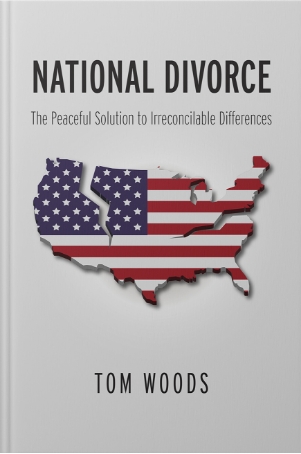
• "Well written, well researched, and the thesis put forth is well argued.... Woods has opened up an area of historical analysis that should invite further study."
    -Journal of American History

  • "During these times that challenge our freedoms there is no one more qualified to make U.S. history relevant to the fight against big government than Thomas Woods."
    -Barry Goldwater Jr.
    Former Member of Congress

  • "I strongly recommend Woods's work."
    -The Honorable Ron Paul,
    U.S. House of Representatives

  • "Written with great clarity and fluency, making the complex philosophical and theological concepts approachable."
    -Journal of American Studies

  • "A must-read."
    -Barron's

  • "An excellent reading source for anyone interested in financial markets, and much more so for anyone interested in learning about capitalism without all the misinterpretations being thrown about in the financial media."
    -Asia Times

  • "Provocative, well-written, and deserves to be read."
    -Catholic Historical Review

  • "An engaging and important contribution to scholarship on the history of American Catholicism."
    -Journal of the Historical Society

  • "Woods and [co-author Kevin] Gutzman appeal to both left and right in this constitutionalist jeremiad…. The authors' exegeses of the Constitution and court decisions, heavy on original intent arguments, are lucid and telling."
    -Publishers Weekly

  • "A marvelous read. Every chapter taught me something new and unexpected."
    -Tom Bethell, senior editor,
    The American Spectator

  • "The hottest book today is Meltdown, by my friend Tom Woods."
    -Judge Andrew Napolitano, senior judicial analyst,
    FOX News Channel

  • "Should be required reading."
    -Economic Affairs (London)

  • "Woods, one of the best classical liberal [libertarian] scholars of his generation, has once more placed us in his debt with this lucid and tightly argued book."
    -David Gordon, The Mises Review

  • "Tom Woods is one of my dearest allies in the struggle against wrong-headed and dangerous economic policy."
    -Peter Schiff

Some Guy: Ron Paul Doesn’t Know the Constitution

A guy named Paul O’Rourke wrote a nasty blog post today claiming that Ron Paul doesn’t know what he’s talking about when it comes to the Constitution.  I always find it funny when conventional left-liberals like O’Rourke single out Ron Paul of all people for criticism, when (here as elsewhere) he knows more about the subject than the rest of the Republican contenders put together.  (Really, Paul, you think you’d have a useful constitutional discussion with Tim Pawlenty?)  They can’t stand an anti-establishment candidate, so they focus their anger on him.  As I never tire of saying, these people want us to shut our mouths and be content with the Biden/Romney spectrum.

Here are the key points to bear in mind:

The merchant marine health-care thing is supposed to prove that Ron Paul’s view of the Constitution is wrong.  But how could it?  It is indisputable that the Constitution was sold to the people in the ratifying conventions in a particular way.  Federalists refuted expansive interpretations of the general welfare clause, brought forth by concerned Antifederalists, with reminders that the federal government would have only the powers “expressly delegated” to it (and yes, the word “expressly” was used, again and again).  Patrick Henry was one such skeptic, and he was thus reassured by Edmund Randolph and George Nicholas, no mean authorities. Thus any interpretation of the clause other than Madison’s couldn’t possibly be correct.  It is the ratifiers whose opinions count, as Madison explained, since what they believed themselves to be agreeing to is what binds us.

The fact that years later the Constitution is violated cannot undo the brute fact that that document was ratified with this particular understanding.  The word “ratifiers” appears nowhere in the O’Rourke piece.  There is a reason for that.

Jefferson said that no matter how long the British had oppressed us, the length of time of such oppression would not have legitimized it.  Indeed.

If I entered into a contract with Paul O’Rourke on the basis of a particular understanding, and then turned around and violated that understanding, first in small things and then in great, what would he say?  Would he say, “Hey, you’re violating our agreement”?  If so, I guess I could come back with, “You’re living in the past, man!  I’ve been violating that agreement for years!”

Alexander Hamilton is cited on behalf of O’Rourke’s interpretation of the general welfare clause.  Prior to ratification, as I show in my 33 Questions book, Hamilton had taken a much less expansive view of the clause.  Once the Constitution was safely ratified, he came out in favor of the position O’Rourke cites.  Does that not strike you as a bit, well, sneaky?  Why should we take Hamilton’s post-ratification view as the definitive one?  Wouldn’t it make far more sense to cite the view Hamilton actually peddled to the public at the time of ratification?

Also, why stop with adopting Hamilton’s post-ratification view of the general welfare clause?  Why not adopt Hamilton’s whole program?  We could have presidents elected for life, senators elected for life, state governors appointed by the president, etc.  Hamilton also favored enforcement of the Sedition Act.  Oh, and you know how the Sedition Act was justified?  With the general welfare clause!

Then we read about Joseph Story, who adopted Hamilton’s post-ratification view of the general welfare clause, and whose views we are urged to adopt.  We are not told that Story had opponents.  But he did.  Abel Upshur mercilessly dismantled Story in his book A Brief Enquiry into the True Nature and Character of Our Federal Government. Story’s view of the Constitution was long ago exploded as unhistorical; see James McClellan’s Joseph Story and the American Constitution: A Study in Political and Legal Thought.  His comments on the general welfare clause, written before Madison’s notes from the convention had been made public, are rooted in highly debatable inferences from the constitutional text.

Continuing with O’Rourke, why is it impossible for the Supreme Court to have been wrong in U.S. v. Butler when it held that the taxing power was not limited by the enumerated powers in Article I, Section 8?  The whole justices-as-infallible-overlords thing is a bit creepy.  Moreover, in that decision the Court overturns the Agricultural Adjustment Act on the grounds that it involved the exercise of a power not delegated to the federal government by the states.  Is O’Rourke really of the view that the federal government has no authority over agriculture?  I doubt it.  So he dissents from the most critical part of this case.  Why does he jump up and down with glee regarding one aspect of the decision and remain perfectly silent about the other?

Then to read that the Founders weren’t classical liberals and that this is just a right-wing myth, well, that’s a bit much.  Of course, the Founders were not a homogeneous blob, and some favored more power for government than others.  But O’Rourke’s insistence on calling the Constitution and Declaration “liberal,” by which he intends the modern, 21st-century, Barack Obama meaning, is beyond absurd.

O’Rourke’s ignorant comments about the words “We, the People” alone prove he is not entitled to an opinion. This is not an example of “collectivism.” The original words were “We, the States.”  This was changed by the Committee on Style, without a single dissenting vote, so it obviously did not involve a matter of substance.  “We, the People” refers to the peoples of the states — the people of Massachusetts, the people of Virginia, etc.  What is supposed to be “collectivist” about that?  No originalist denies — and indeed all of them affirm — that the U.S. was the creation of a group of separate and distinct societies.

In case you need evidence that Jefferson was indeed a classical liberal rather than a liberal in the tradition of Hillary Clinton, you can find it in the excellent new book by Marco Bassani, Liberty, State, and Union: The Political Theory of Thomas Jefferson.

In the comments section of the O’Rourke piece you can see further how confused our author is.  He thinks we have seen a major move in the direction of the free market over the past 30 years, and that this is the reason for our current problems.  If that were so, I wonder why the most free-market economists were the ones most likely to predict the crash.  Were they repudiating their own position?  Or did they see something a teensy bit non-free-market in the activities of the Federal Reserve, the government interventions into the housing market, the regulations that make it impossible to discipline management at financial firms, the prudential regulation that encouraged everyone to flock into AAA-rated MBS, etc.?

As usual, Ron Paul was right, and his snooty critics, who insist on picking on the rare non-drone in politics, dead wrong.

Unlearn the Propaganda!

  • LibertyBelle

    After reading Lysander Spooner a few years ago, I assumed the “oath” to uphold the constitution was necessary as it could not be a binding contract to any other then the original men (or generation) who ratified it.  Non-binding in to future generations, hense, the oath would be required…??? Any comments on my common sense reasoning?

  • http://pulse.yahoo.com/_IVCSAFO6MV66OLM4AAPTSUM44Q Jason

    You must interpret in context. The first Enumerated Power, read in context, specifically states that Congress has the power to tax in order to provide for the defense of the United States as a whole. That’s it. There is no wiggle room. This is the general welfare only in the sense of not becoming dead because we prepared to defend ourselves. It means a national military in order to protect from international attacks. 

    I love the misconstruction of tying Congress’ hands with the Enumerated Powers. Is Congress the only problem solving institution in this country? Do you need someone to hold your hand and solve all of your problems for you, or have you developed past the stage of a lemming? Do you not suppose that our founders had been around and seen enough in their lives to accurately predict how the government would attempt to abuse power? For God sakes, man, they had Britain breathing down their necks every single day and demonstrating what not to do. Whatever hand tying was done to Congress was intentional, preplanned, and calculated. There is no challenge that cannot be dealt with while keeping the Feds within their Constitutional boundaries. We only resort to federalism when it is the best or only choice, and the Constitution does a hell of a job at defining the 17 situations where that is the case. Life changes, we adapt, and the States have the capability and responsibility to change with them–not the Feds, absent an Amendment. 

  • Luke

    At the time Fascism was also unapologetic ally nationalist
    as opposed to the early communist movement which was anti-nationalist (usually)
    i.e. workers of the world unite.   However, once in power the communists
    quickly became extremely nationalist.  In
    practice the two are virtually identical and a total horror show—although they definitely
    saw each other as enemies and opposites.

     In theory, Fascism
    allows technical private ownership but the government tells everyone what to
    do.  It is said someone asked Hitler why
    he didn’t nationalize more industries like Stalin.  He replied, “Why would I need to own the
    business? I own the man.”

    The left right spectrum gets silly quickly—what is
    considered left or right changes often. 
    Not only did libertarians once hold the term liberal, libertarians where
    also considered the left-wing while mercantilism was the position of the
    conservatives.   


  • http://www.facebook.com/ramon.johannessen Ramon Johannessen

    I love when people expose liars with such politeness and class…it must have been difficult to restrain from calling the man what he is: an ignoramus. Well-done and thank you for your continued defense of the truth, liberty, freedom, and Ron Paul. You inspire me to no end!

    RON PAUL 2012!!!

  • http://www.facebook.com/ericevans9377 Eric Evans

    Indeed, Tyler. I read Mr. O’Rourke’s article and had to shower afterward.

  • slmcmillen4

     No, Ron Paul is right and the judges decisions were wrong and need to be reversed.  It is as simply as that.  You are arguing that because the judges made a bad decision we are stuck with the bad decision because now the bad decision has been transformed into “the right” decision just because it was made.  That is what the word repentance is all about.  When one makes a decision to go off in the wrong direction there still remains two options:  1. Continue to go in the wrong direction.   2. Turn around and head in the right direction.

    It is really as simple as that.

  • Jim

    A corporate body is bound by its contracts as long as the body is in existence or formally repudiates them and is absolved from compliance.  In this case the contract was agreed to by the individual states and is still binding.  The Constitution was a contract amongst the states, not the state and the federal government.  The states bound themselves to each other under the terms of the Constitution.  If the contract is repressive it is up to the states to undo it.  

    The purpose of the Constitution was to *prevent* plunder by a centralized government.  When such actions occur it is up to the states to step in to correct the behavior.  So far they haven’t.  They need to.  Apathy doesn’t negate the agreement nor does it give license to abusers.

    Constitutional interpretation has to be taken in the way *all* documents are interpreted by courts right up until today.  That is by the original intent of the parties that drafted the agreement.  Documents that expressly state those intents are available in the ratifying notes and the Federalist papers along with personal letters and memoranda.

    The founders were representatives of the states that planned to renew their contract under better terms.  The new contract was sent back to them for approval and ratified after changes were made to satisfy most of the concerns.  Unlike today, the electorate was very involved with their government and you can’t judge their situation by looking at today’s apathy.

    The Constitution is fully binding on all state representatives to the Federal Congress as well as all members of the Federal Government.  They all must take an oath to uphold it.

    Just about every point you make is factually untrue.  I’m not to sure what you are trying to prove but I think you have failed.

  • http://www.facebook.com/people/Ray-Cote/1452017147 Ray Cote

    I think you’ll enjoy this: http://www.youtube.com/watch?v=xSAFBt06Il4

  • http://www.facebook.com/people/Ray-Cote/1452017147 Ray Cote

    The Hamilton-Story interpretation of the General Welfare Clause is grammatically untenable. Providing for the general welfare is not a separate power but rather the reason why Congress is given the power to tax.The enumerated powers is how Congress is allowed to provide for the general welfare. 

  • Martial_Artist

    It is almost predictable. They (the progressives) have no rational response to Mr. Paul’s arguments, and they are most threatened that he, of all the possible candidates opposed to their agenda, is clearly the most threatening from an intellectual and moral perspective. If he wins, and if his past performance in office is an indicator of his future performance, he will sign and veto legislation in accordance with his principles. It is not that the other Republicans have no principles, it is just that the majority of them have as their first principle one they share with the overwhelming majority of Dems, to wit, “the most important objective in the campaign is to see to it that I am elected (or reelected), justified on the basis of “if I am not reelected, I won’t be here to ensure that the right laws are enacted and the bad laws are not.” Which latter, becomes the overriding consideration when those very bills come up for a vote.
    I have, ever since being stationed in D.C. in the 1980s, felt an overwhelming desire to erect a statue to career “elected officials.” It would be an immaculately groomed and immaculately dressed man standing erect, his left hand grasping his lapel, his right hand upraised, index finger pointed at the sky. The index finger would be the outlet of a very low pressure fountain trickling just enough water to keep that finger wet—he is testing the political winds to see which way they are blowing.”

    Pax et bonum,
    Keith Töpfer

  • http://pulse.yahoo.com/_MFXAORWCYJQLWDTDSUYISXZSHQ LetsGetReal

     Congressional Representatives ARE representing the states.  Does that help you get the picture?

  • http://pulse.yahoo.com/_MFXAORWCYJQLWDTDSUYISXZSHQ LetsGetReal

    It seems to me your idea that  “others have no right to coerce them in any way” is a tenant of your imagination.  It bears no resemblance to anything I have read in libertarian articles.  The premise that I have found is more along the lines of “don’t shove your mis-interpretation of the Constitution down my throat because I know what the limitations of the federal government are and I will not put up with your BS…”

  • http://pulse.yahoo.com/_MFXAORWCYJQLWDTDSUYISXZSHQ LetsGetReal

    I can’t believe you would say demanding a return to a small
    central government is “removing people from their own governance”.   Socialists don’t participate in their own
    governance.  They are duped into
    empowering their own tyrants (whether Republican or Democrat).

    In researching the source of the money that went to get Obamacare passed, I went to the Office of the Clerk, U.S.
    House of Representatives lobbying contributions website and researched just who
    gave money for “medical” issues during 2009. 
    Since the volume of contributions was so large, I limited my research to
    those who funneled $1 million or more per contribution.  I discovered that $1.2 billion or (70 percent
    of the total $1.7 billion that qualified) came from pharmaceutical
    companies.  The largest contributor was a
    startup internet drug company that did not exist prior to 2003.  That one company managed to
    funnel $990 million (almost a billion) into the pockets of lobbyists and
    politicians.  Contributions continued into 2010, but I didn’t include that in my research.  The “carrot” they were scrambling after was $625 billion in stolen taxpayer loot that will be re-distributed through this falsely named legislation.  It should have been named the “Re-distribution of Wealth Act of 2010″.

    When you add the transfer of union dues to democratic politicians to the mix, you end up with the same conclusion, your premise is nonsense.  Whether Republicans or Democrats are elected into office, as long as they walk all over the protections of the original intents of the ratifiers of the Constitution, the end result is a tyrant at the helm.

  • http://www.facebook.com/john.sambdman John Sambdman

    According to contract law, that would make it null and void.

  • http://www.facebook.com/john.sambdman John Sambdman

    Precisely, the proper political scale should read from zero governmental authority to supreme governmental authority. On one end anarchy (no rulers) on the other – fascism, corporatism, communism, monarchy, etc.

  • Anonymous

    great piece tom. keep it up. PEOPLE ARE STARTING TO LISTEN…slowly to be sure, but anything worth having is worth working for

  • JDMinehan

    The major problem with both Mr. Woods view and that of Mr. O’Rourke is that both fail to consider the “necessary and proper” clause.  Both Madison and Hamilton in the Federalist Papers wanted a more flexible grant of power to the Federal Government than existed under the Articles. 

    Under the Articles, EVERY item of POSSIBLE Federal power was enumerated, which was unworkable.  Instead, under the Constitution, the Federal government has vast powers in limited (but vital) areas and the power to effectuate such powers.  If the act of the Federal government was too attenuated, it was ultra vires, but the grant was to do that which was “necessary and proper” NOT “necessary and sufficient,” a position taken by Madison and Hamilton in the Federalist Papers and which formed the holding in the case of McCulloch v. Maryland (1819).

    Thus, if an act of Congress is not in violation of some other provision of the Constitution and is reasonably related to an enumerated power, it is not Unconstitution, even if it is foolish or even dangerous.  As Justice Marshall wrote in a Richmond newspaper in 1819, during an exchange of anounymos letters with Spencer Roane and others, there is no large scale Federal criminal law specified in the Constution, but Congress clearly was able to create the Federal offense of mail robbery, instead of relying on the States to prosecute thefts of mail. 

    US v. Butler was a poorly decided case in that it used less binding persuasive authority (Storey)  to hold that Social Security, a program well outside the ambit of Article I, Sec. 8, was constitutional where under Federalist 41 it clearly is not.  Neither Storey’s Commentaries nor Federalist 41 are binding authorities, however, Federalist 41 is a far stronger authority, having been written by one of the Framers around the time of the Framing.

    Considering the centrality of our merchant fleet in 1798 to Commerce and the fact that the Merchant Navy was both a formal and informal (priviteering) adjunct to our Navy, the 1798 Legislation is clearly NOT patently unconstitutional, if a poor idea.  Social Security does not fit clearly into any enumerated power and is both patently unconstiutional and a bad idea.  In the same way, Congress may well have been able to require militia members to acquire a musket and powder and shot under the Northwest Ordinance of 1787, based on its power to train and make rules for the governance of the militia, but it likely does not have the power to make people acquire health insurance under PPACA where the link to Federal power is vastly more attenuated and other provisions of the Constitution may be violated.   

  • JDMinehan

    The major problem with both Mr. Woods view and that of Mr. O’Rourke is that both fail to consider the “necessary and proper” clause.  Both Madison and Hamilton in the Federalist Papers wanted a more flexible grant of power to the Federal Government than existed under the Articles. 

    Under the Articles, EVERY item of POSSIBLE Federal power was enumerated, which was unworkable.  Instead, under the Constitution, the Federal government has vast powers in limited (but vital) areas and the power to effectuate such powers.  If the act of the Federal government was too attenuated, it was ultra vires, but the grant was to do that which was “necessary and proper” NOT “necessary and sufficient,” a position taken by Madison and Hamilton in the Federalist Papers and which formed the holding in the case of McCulloch v. Maryland (1819).

    Thus, if an act of Congress is not in violation of some other provision of the Constitution and is reasonably related to an enumerated power, it is not Unconstitution, even if it is foolish or even dangerous.  As Justice Marshall wrote in a Richmond newspaper in 1819, during an exchange of anounymos letters with Spencer Roane and others, there is no large scale Federal criminal law specified in the Constution, but Congress clearly was able to create the Federal offense of mail robbery, instead of relying on the States to prosecute thefts of mail. 

    US v. Butler was a poorly decided case in that it used less binding persuasive authority (Storey)  to hold that Social Security, a program well outside the ambit of Article I, Sec. 8, was constitutional where under Federalist 41 it clearly is not.  Neither Storey’s Commentaries nor Federalist 41 are binding authorities, however, Federalist 41 is a far stronger authority, having been written by one of the Framers around the time of the Framing.

    Considering the centrality of our merchant fleet in 1798 to Commerce and the fact that the Merchant Navy was both a formal and informal (priviteering) adjunct to our Navy, the 1798 Legislation is clearly NOT patently unconstitutional, if a poor idea.  Social Security does not fit clearly into any enumerated power and is both patently unconstiutional and a bad idea.  In the same way, Congress may well have been able to require militia members to acquire a musket and powder and shot under the Northwest Ordinance of 1787, based on its power to train and make rules for the governance of the militia, but it likely does not have the power to make people acquire health insurance under PPACA where the link to Federal power is vastly more attenuated and other provisions of the Constitution may be violated.   

  • http://www.facebook.com/matt.tanous Matthew Tanous

    Of course, he ignores the words of the founders as to what “general welfare” actually meant:  ”With respect to the two words ‘general welfare,’ I have always regarded them as qualified by the detail of powers connected with them. To take them in a literal and unlimited sense would be a metamorphosis of the Constitution into a character which there is a host of proofs was not contemplated by its creators.” – James Madison

Find me on Google